
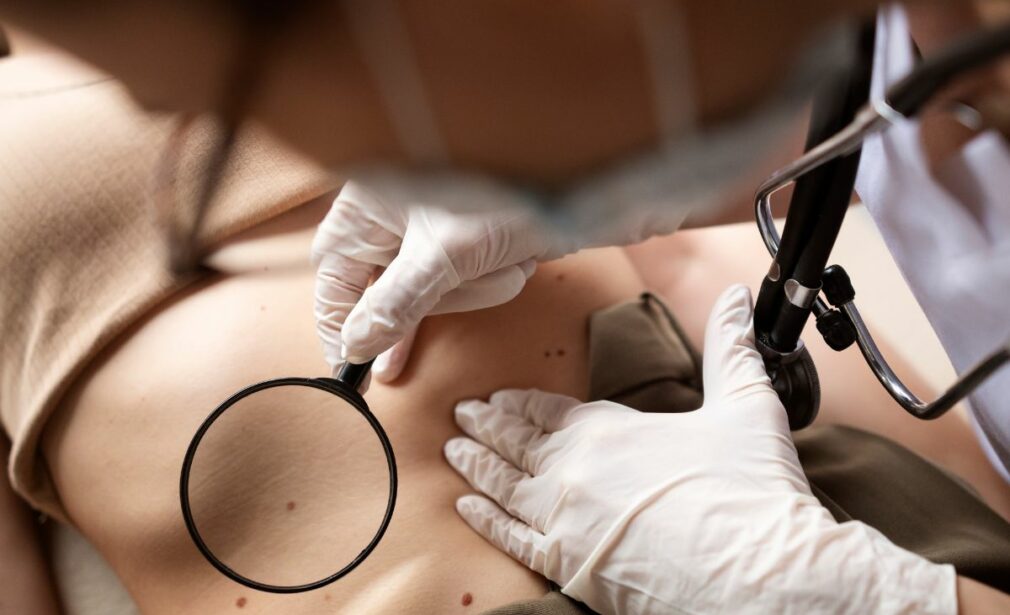
Skin Checks in Nerang, Gold Coast
Nerang Medical Centre & Skin Clinic provides full-body skin checks for people across Nerang and the Gold Coast. Living in Queensland means high year-round UV exposure, so regular skin checks are an important part of looking after your health. Our GPs examine your skin using a dermatoscope (a special magnifying tool), check moles, spots and lesions, and explain clearly what they find and any next steps. No referral is needed, and we’re open 7 days a week.
Why skin checks matter on the Gold Coast
Australia has one of the highest rates of skin cancer in the world, and around two in three Australians are diagnosed with some form of skin cancer by age 70 (source: Cancer Council Australia). Most skin cancers are linked to UV exposure – and with the Gold Coast’s sunny climate, that risk is part of daily life here. The good news is that when skin cancers are found early, they can often be treated effectively, which is why regular checks and knowing your own skin matter.
What happens during a skin check
A skin check is straightforward and private. Your GP will:
- ask about your history, any spots you’re worried about, and your risk factors
- examine your skin from head to toe in good lighting
- use a dermatoscope to look more closely at any moles or lesions
- explain what they find and talk through any recommended next steps.
A full-body check usually takes around 15–30 minutes. You’ll be asked to undress to your underwear and given privacy and a gown; let us know if you’d prefer a chaperone, or a female or male doctor. It helps to remove nail polish and heavy make-up beforehand, and to point out anything new or changing.
Noticed a new or changing spot? Don't wait - book a skin check online or call
What we look for
Skin cancers generally fall into three main types:
- Melanoma – less common but more serious, as it can spread; often appears as a new or changing mole.
- Basal cell carcinoma (BCC) – the most common skin cancer; usually slow-growing.
- Squamous cell carcinoma (SCC) – common; can grow more quickly than BCC.
Your GP will also check for sunspots and other skin changes, and advise whether anything needs monitoring or further assessment.
Know your skin — the ABCDE guide
Between checks, it helps to keep an eye on your own skin. See a doctor if a mole or spot shows any of the ABCDE signs:
- A — Asymmetry: one half doesn’t match the other
- B — Border: edges are irregular, ragged or blurred
- C — Colour: uneven, or more than one colour
- D — Diameter: changing in size (often larger than 6mm)
- E — Evolving: changing in size, shape, colour, or starting to itch or bleed
Also see a doctor about any new spot, a sore that won’t heal, or anything that looks different from your other spots. If you’re ever unsure, it’s always worth getting it checked.
Who should have regular skin checks?
It’s worth talking to your GP about regular checks if you:
- have fair skin, or skin that burns easily
- have had significant sun exposure or sunburn, especially in childhood
- work or spend a lot of time outdoors
- have many moles, or unusual moles
- have a personal or family history of skin cancer.
How often you should be checked depends on your individual risk – your GP will recommend a schedule that’s right for you.
If we find something that needs a closer look
If your GP notices a spot that needs further assessment, they’ll explain why and discuss the options with you. Depending on the situation, this may include taking a small sample (a biopsy) or removing the lesion, 【either here at the clinic or by referral — confirm what is done on-site】. Any surgical or invasive procedure carries some risks, which your doctor will explain before proceeding, and you’re welcome to ask questions or seek a second opinion.
Fees & Medicare
Bulk billing is available for eligible Medicare patients with participating doctors. Many skin check consultations are covered by Medicare for eligible patients; some procedures (such as a biopsy or removal) may involve an out-of-pocket cost, and procedures done purely for cosmetic reasons are generally not covered by Medicare. Billing can vary by doctor and appointment type – please check the doctor’s profile, see [Bulk Billing & Fees], or call (07) 5620 3633.
Looking after your skin
Alongside regular checks, sun protection helps reduce your risk: slip on clothing, slop on SPF 50+ sunscreen, slap on a hat, seek shade and slide on sunglasses – especially during the middle of the day. Your GP is happy to answer any questions about protecting your skin.
Frequently asked questions
You can have a full-body skin check with our GPs at Shop 7/57 Station Road, Nerang – inside My Centre Nerang. No referral is needed. Book online or call (07) 5620 3633; we’re open 7 days a week.
No. You don’t need a referral to book a skin check with our GPs. Simply book online or call us.
Your GP asks about your history and any concerns, examines your skin from head to toe, and uses a dermatoscope to look closely at moles and spots. They’ll explain what they find and any next steps. It usually takes around 15–30 minutes.
It depends on your individual risk – including your skin type, sun exposure and personal or family history. Your GP will recommend how often you should be checked. If you notice a new or changing spot in between, book sooner.
ABCDE stands for Asymmetry, Border, Colour, Diameter and Evolving – signs that a mole may need checking. See a doctor about any spot that shows these signs, a new spot, or a sore that won’t heal.
Yes. We have both female and male GPs, and you’re welcome to request a chaperone. Let our reception team know your preference when you book.
Living on the Gold Coast? Book a skin check at our Nerang skin clinic.
Full-body skin checks with dermoscopy for the early detection of skin cancer. No referral needed.